September 11, 2018

The Great Living Chola Temples


One of the earliest and longest ruling dynasties of southern India, the Cholas ruled between the 9th century and 13th century even though there have been reports of their establishment much before in 3rd century BC. Cholas expanded their kingdom and it is believed they held sway over regions of Maldives, Sri Lanka and probably even Malayasia and Indonesia. The empire reached its peak around the 11th century when it was ruled by Rajaraja Chola I, the greatest of Chola kings and then by Rajendra Chola, his son. The dynasty also left behind a great legacy in the form of some stupendous temples adorned with magnificent sculptures and carvings. The Great Living Chola Temples which is a UNESCO World Heritage site is a prime example of this. The site constitutes of three temples- Brihadeeshwarar temple at Thanjavur, Airavateswarar temple at Darasuram and Brihadeeshwarar temple at Gangaikondacholapuram. Built in typical Drvaidian architecture, the three temples deeply signify the Chola style and ideology with regard to architecture and art. All the three temples are located in the Cauvery delta regions surrounding Thanjavur and Kumbakonam in Tamil Nadu.

Brihadeeshwarar temple, Thanjavur

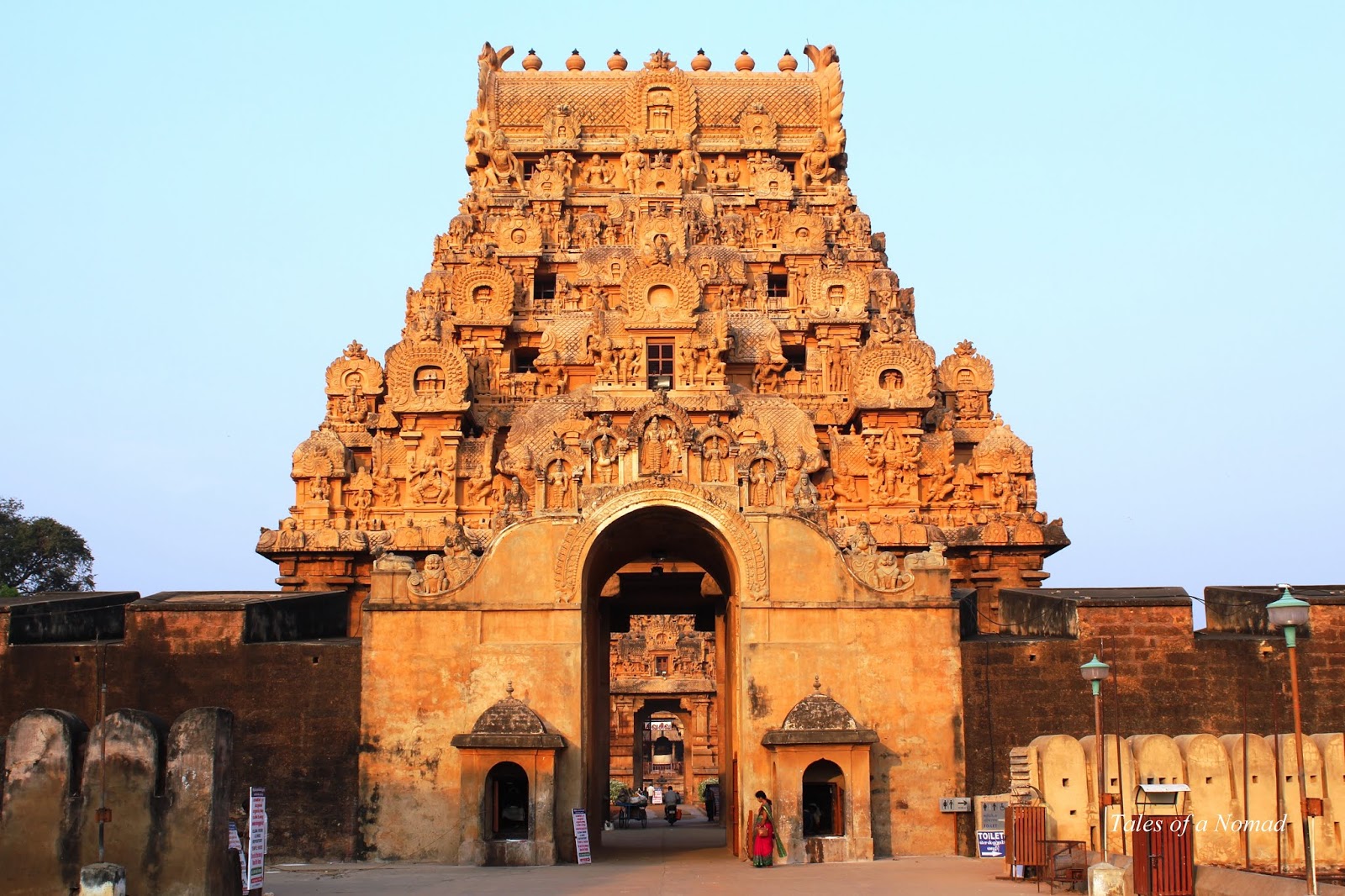
Also referred as the Big temple or Periya kovil locally, Brihadeeshwarar temple is the cynosure of all eyes visiting Thanjavur. Built in early 11th century by Rajaraja Chola I, the temple is located within Shivganga fort in the city and has a moat running around it. It was built and designed to represent a cosmic structure- the Mahameru (a sacred 5 peak mountain) and had granite blocks being brought from more than 50 Kms away for its construction. The two large entrance gates dedicated to Karalantakan and Rajaraja Chola I are extensively carved with beautiful sculptures of figurines and mythological characters. The second thiruvasal (entrance gate) opens into the sprawling courtyard of the temple with the intimidating 13 storeyed gopuram of the main shrine garnering all attention. Spread over 33,000 sq ft, the temple is dedicated to Shiva and has a large shivlinga as the main shrine. The vimana or tower above the main sanctum is extensively and intricately carved and also has an 80 tonne carved granite block atop it. While the inner walls are devoid of carvings, the outer façade of the main shrine is adorned with extensive chisel work. Apart from the carvings that depict various mythological stories and characters, there are also inscriptions of various rulers. The temple has a wide circumambulatory path which is lined with pillared pathways all along. The complex also houses numerous other shrines dedicated to Chandikesvara, Ganesha, Varaha, Karuvur Devar, Nataraja etc. However, the shrines of Subramanya, Amman and the colossal Nandi are the ones which have beautiful frescoes and sculptures. The temple underwent numerous repairs and renovations during the rule of later dynasties and even had a few shrines added in the same period. The temple looks gorgeous during sunrise and sunset when the backdrop is bathed in shades of yellow, orange and red.

Location: In Thanjavur city


Airavateswarar temple, Darasuram

Named after Indra’s vehicle, Airavat (elephant), the temple is dedicated to Airavateswarar and Shiva. Built in the 12th century by Rajaraja Chola II, the temple is located in Darasuram near Kumbakonam and is a part of a cluster of medieval temples in the same region. The temple is surrounded by a moat and is located inside a well kept garden with a nandi mandapa just outside the courtyard. It has a beautifully sculpted entrance gate and a pathway inside which runs all along with numerous carved pillars. The main sanctum which is extensively sculpted is on a raised platform which is in the shape of a chariot pulled by horses and is a smorgasbord of sculptures. The outer façade has intricate sculptures of mythological characters and the steps that lead up the raised platform too have carvings on them. The platform which leads to the inner sanctums has innumerable ornate pillars with astounding carvings and sculptures which are intricate and depict stories related to Shaivism and Vaishnavism. These sculpted pillars are magnificent and are truly one of the highlights of this temple. The ceilings too have beautiful carvings, most of which have worn out. The temple is also adorned with numerous small sculptures of various deities and has inscriptions on its walls. The extensive detailing is the stand out feature of Airavateeshwarar temple, which makes it at par or a notch above the big temple at Thanjavur with regard to the stone works. The complex supposedly had more courtyards and structures when it was built, but most of those got ruined over the years. 

Location: 36 Kms from Thanjavur and 4 Kms before Kumbakonam


Brihadeeshwarar temple, Gangaikondacholapuram

When Rajendra Chola I became the king of Chola dynasty, he shifted the capital from Thanjavur to Gangaikondacholapuram to commemorate his conquest up to the banks of river Ganga. Located in the nondescript village of Gangaikondacholapuram, the Brihadeeshwarar temple here is modeled on the big temple in Thanjavur. The complex is set inside a neatly maintained lawn with sporadic trees. The main shrine dedicated to Shiva has a square plan with a tower atop the inner sanctum. The tower has sculptures all over similar to the Brihadeeshwara temple in Thanjavur but is nine storeyed instead of thirteen. The outer façade has innumerable sculptures of gods and other mythological characters. There is a huge nandi sculpture in front facing the temple. Th premise also has a few other shrines dedicated to various deities. Though it is built similar to the one in Thanjavur, it fails to match up to the architectural extravagance of the big temple.

Location: 72 Kms from Thanjavur and 32 Kms from Kumbakonam


Navigator:

Thanjavur is 59 Kms from Tiruchirappalli, 190 Kms from Madurai and 346 Kms from Chennai. The nearest airport is at Tiruchirappalli. There are frequent trains and buses connecting Thanjavur with all the major towns in south India. Thanjavur and Kumbakonam are 40 Kms apart.

Food and Accommodation:

It is recommended to stay at Thanjavur and travel to all the three temples. Thanjavur has numerous hotels and restaurants. There are small make shift shops outside these temples.

September 7, 2018

My favourite iconic breakfast places in Bangalore


Bengaluru is often referred as the pub capital of India and it is not without a reason, as you can always spot a new pub every week in Indira Nagar or Koramangala. Same goes with cafes, as the culture has strongly caught up with the silicon capital of India with innumerable cafes with various themes across the city. However, when you talk about the iconic places for breakfast in the city, it is a stroll back to the days of the 20th century Bangalore. That was a period when many restaurants such as Mavalli Tiffin Room, Vidyarthi Bhavan, Central Tiffin Room, Veena Stores, Koshy’s, Peco’s, Airlines hotel and many more thrived and had even personalities from various fields visiting them for the delicious dosas, idlis, appams and coffee. Many such restaurants have shut down over a period of time due to various reasons. Thankfully, a few of them have survived the urbanization and café culture to serve delicious breakfasts and satiate the taste buds of their guests and fans.

If you aren’t a Bangalorean, but still would like to explore these breakfast options, do not ponder much and book flight online to Namma Bengaluru at the earliest. The city is well connected with all major metros and there are frequent Mumbai to Bangalore flights, New Delhi to Bangalore flights, and Chennai to Bangalore flights and Pune to Bangalore flights.

Though it was tough to pick, here is a short list of my favourite iconic places in Bangalore for some scrumptious breakfast. Am sure there are more which you would like to add to this and I look forward to those in the comments.


Mavalli Tiffin Room:

One of the oldest breakfast places in Bangalore, MTR as it is fondly called, first served idlis and dosas in 1924. The legendary place is synonymous with Karnataka food and is known for their crisp masala dosas, idlis and tumbler coffee. MTR also claims to have invented rava idli which they experimented during WWII when idli was scarcely available. The place is crowded through the day and it is recommended to head there early for breakfast.

Must try: Rava Idli and Masala dosa

Located next to Urvashi theatre near Lalbagh, MTR is open from 6.30 AM to 11 AM, from 12.30 PM to 2.30 PM and from 3.30 PM to 8.30 PM.


Vidyarthi Bhavan:

Vidyarthi Bhavan opened in 1943 for students and has been serving lip smacking dishes ever since. The old fashioned ambience with wooden benches, portraits of personalities and slow service (due to the rush) takes you back a few decades and reminds you of the typical old Bangalore. Vidyarthi bhavan is popular for its khara bath, masala dosas (with the delicious chutney) and coffee. The place gets quite crowded during weekends and you may have to wait until your name is called out to get hands on those crisp dosas.

Must try: Masala dosa

Located on Gandhi Bazaar main road in Basavanagudi, Vidyarthi bhavan is open from 6.30 AM to 12 noon and from 2 PM to 8 PM.


Koshy’s:

A melting pot for artists, journalists, writers and many others, this establishment which opened its doors in 1940 has served quite a few personalities including former Prime Minister, Jawaharlal Nehru and Queen Elizabeth II. Known for their Kerala cuisine and English breakfast, Koshy’s comprises of Parade café and Jewel box. While Jewel box looks quite contemporary, Parade café with its old wooden tables, old fashioned fans and laid back ambience has the charm that would make sure that you stretch your breakfast to lunch at the same table. Koshy’s is probably my favourite in this list and four generations of my family has visited this iconic place.

Must try: Minced mutton toast and English breakfast

Located onSt. Mark’s road at the intersection of M.G.Road, Koshy’s is open from 9 AM to 11.30 PM.


Airlines hotel:

An open air restaurant surrounded by trees, Airlines hotel has an incredibly charming ambience. Known for their one by two coffees, kesari baths and dosas, this is an ideal place to chat gleefully listening to the chirping of birds. A filter coffee, a book and the calm surroundings of Airlines hotel are an ideal way to start your weekend. Though it did close down for a while, Airlines hotel is back in action doing the best they are known for- satiating taste buds.

Must try: Dosas and Channa Battura

Located on Madras Bank road, off Lavelle road, Airlines hotel is open from 7 AM to 10 PM.


P.S.: This post is in collaboration with Jet airways but opinions are my own.

September 4, 2018

Dhanushkodi- Land’s End


The crumbling structures, the people, the sands, the waves- they all tell you the same horrific story of the night of 1964 when Dhanushkodi, a flourishing sea side town was washed away by a cyclone and turned into a ghost town overnight. A walk around this fishing hamlet reveals the aftermath of the fateful December night when more than 1800 people died. Declared unfit for living, Dhanushkodi was again hit during the tsunami in 2004, but still survived to tell another tale. Located 19 Kms from Rameshwaram and 27 Kms from Talaimannar in Srilanka, Dhanushkodi is the last stretch of land across Pamban bridge which connects with mainland India. Outstretching into the Bay of Bengal, Dhanushkodi borders the Gulf of Mannar, and Arichalmunai which is a further 4 Kms is the last point in India, beyond which lies the submerged Adam’s bridge or Ram Sethu connecting Sri Lanka.

The long road from Rameshwaram gets deserted after the initial few kilometers and then the backwaters of Bay Bengal accompany you all the way. The road is well laid out all the way till Dhanushkodi, which wasn’t the scenario two years back. Visitors had to take public jeeps for the last five kilometers of sandy stretch. However, the new road has made the commutation easier for people. There are a couple of thatched shops selling shells and other curios along the stretch from Rameshwaram to Dhanushkodi. Dilapidated structures and abandoned houses appear as you near the ghost town. The remaining structures of the Dhanushkodi railway station which was swept along with more than a 100 people aboard a passenger train pops up just before the town. The station here once had trains running between Dhanushkodi and Chennai. On the right, there are many make shift shops that sell curious, shells, fruits and water to visitors. 


The narrow pathway amidst the shops leads to the beach. Where the shops end stands tall the walls, a couple of arches and the base of altar of a catholic church. Beyond this the sands lead you to the blue sea. A walk along the beach takes you to the remains of more structures and homes that belonged to the people of Dhanushkodi more than half a century ago. The beach gives a tinge of eeriness as you stroll along the shoreline away from the shacks. The waves are pretty strong through the day and the sunset is captivating. All the shop keepers and others head back to Rameshwaram and surrounding areas once the sun sets and only a few fisher folk stay here.


The road from here runs parallel to the sea to Arichalmunai, where a replica of the Ashoka Pillar receives visitors. One can literally see the end of land here and locals say that lights in Talaimannar can be sighted on a clear night. There isn’t much to do in Arichalmunai other than gaze at the tip of India and capture some lovely sunset frames. Coast guards are quite vigilant here and visitors are asked to leave by 6 PM.


Dhanushkodi is not your typical tourist destination as it doesn’t have much on offer except for the beautiful landscape. However, what it can tell you are many horrifying stories that it has lived through.


Navigator:

Dhanushkodi  is 29 Kms from Rameshwaram. Autorickshaws can take you to Dhanushkodi from Rameshwaram. However, it is recommended to have your own vehicle if you would like to spend time. The closest railway station is at Rameshwaram and the nearest airport is at Madurai. There are regular buses and trains from Madurai and  Chennai to Rameshwaram.

Food and Accommodation:

There are no restaurants and hotels in Dhanushkodi except for a few shacks. Rameshwaram has numerous restaurants and hotels.

August 28, 2018

Places to visit in Rameshwaram


The two significant things that relates to the island of Rameshwaram are Ramayana and the engineering wonder, Pamban bridge.  Located along coastal Tamil Nadu, Rameshwaram lies adjacent to Dhanushkodi which is geographically the closest Indian destination to Sri Lanka, separated by the Gulf of Mannar. Rameshwaram is a prominent religious centre and is deeply connected with Ramayana as it is believed that Rama and his army crossed over from here to Sri Lanka. The temple town is also known for Ramanathaswamy temple dedicated to Shiva. Apart from the mythological aspects, the splendid sea and spectacular sunsets are absolutely alluring in this small island.

Ramanathaswamy Temple:

Expanded during the 12th century by the Pandya kings, Ramanathaswamy temple has a shivling as the main shrine which is believed to have been consecrated by Rama upon his return from Sri Lanka. It is one of the twelve Jyotirlinga temples in the country and houses the longest temple corridor in India which is lined with more than a thousand pillars and colourful ceilings. The temple is also known for its 22 theerthams (holy ponds) where pilgrims queue up to be watered by priests and move from one well to another. It is believed to be auspicious to have a bath from the waters of all the wells before entering the inner sanctum of the temple. The temple has four large gopurams (entrance gates) of which the eastern gate is the tallest (173 feet) and has tall walls surrounding it. The lanes around the temple sell myriad things from temple paraphernalia to sea shells to curios. 


Theerthams:

Also known as holy ponds, there are 64 Theerthams present across the town of Rameshwaram. The most popular one is Agnitheertham, which is actually the shallow stretch of sea behind Ramanathaswamy temple. Almost all the pilgrims take a dip here prior to their visit to the temple.  Ramar theertham was where Rama took a dip and there is a Rama temple next to it. The gorgeous Lakshmana theertham is where Lakshmana took a dip to cleanse off his sins and installed a shivlinga. Villondi theertham stretches into the sea and it is believed that Rama shot an arrow into the sea to create this pond to quench the thirst of Sita. Some of the other popular holy ponds are Mangala theertham, Runa Vimochana theertham, Jambhavan theertham, Sugriva theertham and Jata Mukuta theertham. A couple of them such as Angad theertham have become a source of water for the locals.


Gandhamadhana parvatham:

This hillock is the highest point in Rameshwaram and is also believed to house the foot prints Of Rama. The upper storey of the temple offers magnificent aerial views of the green surroundings, the sea and the tall gopurams of Ramanathaswamy temple in the distance.


Panchamukhi Hanuman temple:

Located between Ramar theertham and Laskhmana theertham, this shrine of Hanuman has five faces and is one of the popular temples in Rameshwaram. There is also a display of floating stones from Ram sethu inside the temple. Photography is prohibited inside the premises.

Kodandarama swamy Temple:

Located enroute Dhanushkodi, Kodandarama swamy temple stretches out into the backwaters of Bay of Bengal. A long narrow road leads to this scenic temple which houses the shrine of Rama. It is believed that this is the place where Rama and his army met Vibheeshana (Ravana’s brother) in Ramayana. The inside walls of the temple depicts this part of the story in the form of paintings. The surrounding area is an apt place to spot avian fauna.


APJ Abdul Kalam National Memorial:

Dedicated to the former President of India and renowned scientist, A P J Abdul Kalam, this memorial houses a huge collection of photographs, portraits, life size wax statues and various awards that he had received apart from his personal belongings. It also displays stories from his childhood, his youth, the days as a scientist at DRDO and his tenure as the President of the country. The memorial is a tribute to this great soul and his mortal remains are also kept here. A P J Abdul Kalam was born in Rameshwaram and spent his younger days in this island town. Photography is prohibited inside the premise.


Pamban bridge:

One of the engineering marvels in the country, this 2.3 km long Sea Bridge connects Mandapam on mainland India with Pamban, a small hamlet in Rameshwaram.  Built in 1914 CE, this rail bridge is a cantilevered one which is sometimes raised to let large ships pass through. Running parallel to this is the road bridge which is known as Annai Indira Gandhi bridge. The road bridge offers panoramic views of the rail bridge, endless stretch of blue sea, innumerable moored boats and spectacular sunsets. It is a delight to walk over the bridge to enjoy the sunset as the sky splashes a riot of colours from golden to orange to red to pink to brown to mauve.


Navigator:

Rameshwaram is 170 Kms from Madurai, the nearest city. Though the nearest airport is at Madurai, Rameshwaram has a railway station and has regular connecting trains to Madurai and Chennai. There are frequent buses from Madurai to Rameshwaram.

Food and Accommodation:

The town has numerous restaurants offering a wide range of vegetarian cuisines. It is quite tough to get meat dishes in Rameshwaram. Rameshwaram has many hotels from budget range to the luxurious ones.

August 21, 2018

Sunset over mainland India


The two kilometer long Pamban bridge connects the tip of mainland India with Rameshwaram and Dhanushkodi. This bridge offers spectacular sunset views as the evening sky splashes lovely colours.
Rameshwaram, Tamil Nadu. March 2018.

August 20, 2018

Silhouettes!


Fishing boats moored along the coast of Rameshwaram, Tamil Nadu. March 2018.
Related Posts Plugin for WordPress, Blogger...