Showing posts with label Kumbakonam. Show all posts

December 12, 2018

Popular Temples of Kumbakonam


An hour’s drive away from Thanjavur lies the temple town of Kumbakonam, believed to be where the pot (Kumbham) containing nectar of life was spilled by Shiva. Kumbakonam is one of the prominent temple towns in the Cauvery region and also houses the holy tank of Mahamaham where the nectar pot fell.  The town is lined with colourful gopurams of numerous temples and is also a prominent place for religious studies. From Cholas to Pandyas to Marathas to British, the town was under various rulers over the years.

Though there are more than 80 temples spread across the town of Kumbakonam, here is a list of the popular ones which are a must visit.

Adi Kumbeswarar Temple:

Believed to have been built before the 7th century by the Chola rulers, Adi Kumbeswarar is one of the most important and popular temples in Kumbakonam. Rebuilt and renovated over centuries, the temple has beautiful sculptures from mythology adorning its pillars and walls. The hall that leads to the main sanctum has numerous pillars and its carved ceilings are coloured with vegetable dyes. The temple is dedicated to Kumbeswarar (Shiva) and the main shrine houses a lingam. The premise also has a temple pond, Kandha Kumbha Theertham.


Ramaswamy Temple:

Built in 17th century by the Nayaks, the temple is dedicated to Vishnu. The hall outside the inner sanctum is lined with numerous sculpted pillars which has characters from mythology and related designs. The ceilings too have carved designs and are colourful. The hall also has frescoes of the ten avatars of Vishnu. The inner walls are adorned with paintings depicting scenes from Ramayana.


Sarangapani Temple:

A prominent Vaishnavite temple in India, Sarangapani temple dedicated to Vishnu is the biggest one in Kumbakonam and is built in typical Dravidian style architecture.  The colourful and striking eleven storeyed gopuram is a major attraction of this temple apart from the chariot shaped main sanctum which has numerous carved pillars. The main shrine is of Sarngapani, an incarnation of Vishnu. There is also a shrine dedicated to Komalavalli, the consort of Sarngapani. The temple also houses quite a few other colourful entrance gates.


Nageswarar Temple:

The 9th century temple built during the time of Cholas has Nageswarar as its main deity, a serpentine form of Shiva. While the colourful entrance gate is quite an eye catcher, the inner entrance gate has gorgeous art work on its ceiling. The inner sanctum is in the form a chariot and has sculptures of horses pulling it.


Chakrapani Temple:

Dedicated to Vishnu, the presiding deity is Chakrapani (a form of Vishnu) who is worshipped as Sudarshana. The deity has a third eye on his forehead and eight stretched out arms. Apart from a colourfully sculpted entrance gate, the temple also houses carved pillars and an entrance foyer with art work on the ceiling.


Mahamaham Tank:

Located to the north of Kasi Vishwanathar temple, Mahamaham tank is where the Mahamaham festival (similar to Kumbh mela) is held every 12 years. It is believed that the waters of this tank can get rid of all the sins and is more sacred than river Cauvery. There are many lingams along the banks of the tank and it also houses  numerous wells. 


Navigator:

Kumbakonam is 40 Kms from Thanjavur and 282 Kms from Chennai. There are buses and trains that connect Kumbakonam with major cities across south India. The closest airport is at Tiruchirappalli, 95 Kms away.

Food and Accommodation:

Most of the hotels in Kumbakonam offer vegetarian fare.  The town is also known for its ‘Degree Coffee’ which is served in brass tumblers. The coffee is prepared with thick milk, is boiled to a certain temperature and gets its name due to this. One can either stay in Thanjavur and make a day trip to Kumbakonam or stay in Kumbakonam to visit its temples. There are numerous hotels in both Thanjavur and Kumbakonam catering various budgets.

September 11, 2018

The Great Living Chola Temples


One of the earliest and longest ruling dynasties of southern India, the Cholas ruled between the 9th century and 13th century even though there have been reports of their establishment much before in 3rd century BC. Cholas expanded their kingdom and it is believed they held sway over regions of Maldives, Sri Lanka and probably even Malayasia and Indonesia. The empire reached its peak around the 11th century when it was ruled by Rajaraja Chola I, the greatest of Chola kings and then by Rajendra Chola, his son. The dynasty also left behind a great legacy in the form of some stupendous temples adorned with magnificent sculptures and carvings. The Great Living Chola Temples which is a UNESCO World Heritage site is a prime example of this. The site constitutes of three temples- Brihadeeshwarar temple at Thanjavur, Airavateswarar temple at Darasuram and Brihadeeshwarar temple at Gangaikondacholapuram. Built in typical Drvaidian architecture, the three temples deeply signify the Chola style and ideology with regard to architecture and art. All the three temples are located in the Cauvery delta regions surrounding Thanjavur and Kumbakonam in Tamil Nadu.

Brihadeeshwarar temple, Thanjavur

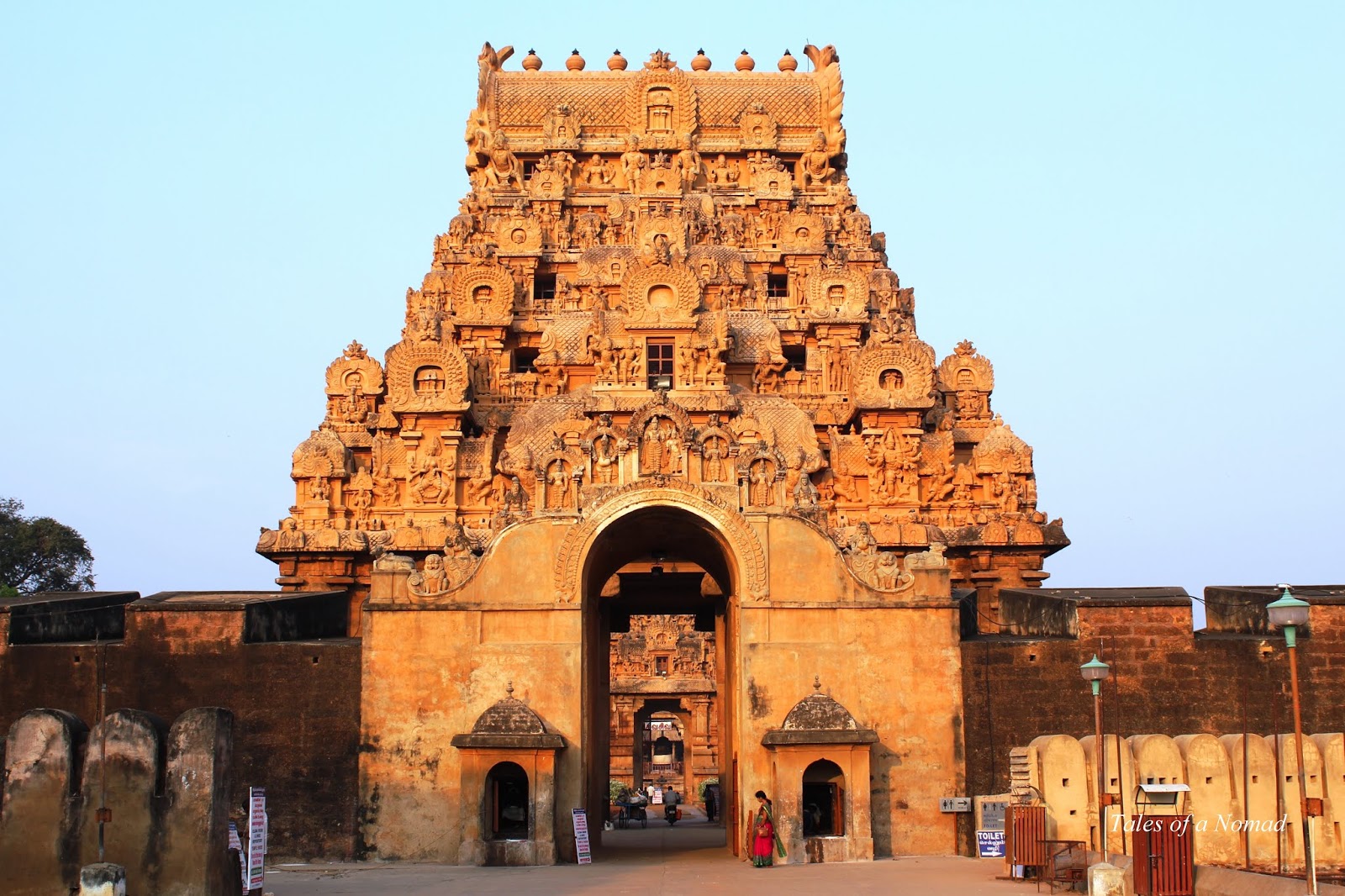
Also referred as the Big temple or Periya kovil locally, Brihadeeshwarar temple is the cynosure of all eyes visiting Thanjavur. Built in early 11th century by Rajaraja Chola I, the temple is located within Shivganga fort in the city and has a moat running around it. It was built and designed to represent a cosmic structure- the Mahameru (a sacred 5 peak mountain) and had granite blocks being brought from more than 50 Kms away for its construction. The two large entrance gates dedicated to Karalantakan and Rajaraja Chola I are extensively carved with beautiful sculptures of figurines and mythological characters. The second thiruvasal (entrance gate) opens into the sprawling courtyard of the temple with the intimidating 13 storeyed gopuram of the main shrine garnering all attention. Spread over 33,000 sq ft, the temple is dedicated to Shiva and has a large shivlinga as the main shrine. The vimana or tower above the main sanctum is extensively and intricately carved and also has an 80 tonne carved granite block atop it. While the inner walls are devoid of carvings, the outer façade of the main shrine is adorned with extensive chisel work. Apart from the carvings that depict various mythological stories and characters, there are also inscriptions of various rulers. The temple has a wide circumambulatory path which is lined with pillared pathways all along. The complex also houses numerous other shrines dedicated to Chandikesvara, Ganesha, Varaha, Karuvur Devar, Nataraja etc. However, the shrines of Subramanya, Amman and the colossal Nandi are the ones which have beautiful frescoes and sculptures. The temple underwent numerous repairs and renovations during the rule of later dynasties and even had a few shrines added in the same period. The temple looks gorgeous during sunrise and sunset when the backdrop is bathed in shades of yellow, orange and red.

Location: In Thanjavur city


Airavateswarar temple, Darasuram

Named after Indra’s vehicle, Airavat (elephant), the temple is dedicated to Airavateswarar and Shiva. Built in the 12th century by Rajaraja Chola II, the temple is located in Darasuram near Kumbakonam and is a part of a cluster of medieval temples in the same region. The temple is surrounded by a moat and is located inside a well kept garden with a nandi mandapa just outside the courtyard. It has a beautifully sculpted entrance gate and a pathway inside which runs all along with numerous carved pillars. The main sanctum which is extensively sculpted is on a raised platform which is in the shape of a chariot pulled by horses and is a smorgasbord of sculptures. The outer façade has intricate sculptures of mythological characters and the steps that lead up the raised platform too have carvings on them. The platform which leads to the inner sanctums has innumerable ornate pillars with astounding carvings and sculptures which are intricate and depict stories related to Shaivism and Vaishnavism. These sculpted pillars are magnificent and are truly one of the highlights of this temple. The ceilings too have beautiful carvings, most of which have worn out. The temple is also adorned with numerous small sculptures of various deities and has inscriptions on its walls. The extensive detailing is the stand out feature of Airavateeshwarar temple, which makes it at par or a notch above the big temple at Thanjavur with regard to the stone works. The complex supposedly had more courtyards and structures when it was built, but most of those got ruined over the years. 

Location: 36 Kms from Thanjavur and 4 Kms before Kumbakonam


Brihadeeshwarar temple, Gangaikondacholapuram

When Rajendra Chola I became the king of Chola dynasty, he shifted the capital from Thanjavur to Gangaikondacholapuram to commemorate his conquest up to the banks of river Ganga. Located in the nondescript village of Gangaikondacholapuram, the Brihadeeshwarar temple here is modeled on the big temple in Thanjavur. The complex is set inside a neatly maintained lawn with sporadic trees. The main shrine dedicated to Shiva has a square plan with a tower atop the inner sanctum. The tower has sculptures all over similar to the Brihadeeshwara temple in Thanjavur but is nine storeyed instead of thirteen. The outer façade has innumerable sculptures of gods and other mythological characters. There is a huge nandi sculpture in front facing the temple. Th premise also has a few other shrines dedicated to various deities. Though it is built similar to the one in Thanjavur, it fails to match up to the architectural extravagance of the big temple.

Location: 72 Kms from Thanjavur and 32 Kms from Kumbakonam


Navigator:

Thanjavur is 59 Kms from Tiruchirappalli, 190 Kms from Madurai and 346 Kms from Chennai. The nearest airport is at Tiruchirappalli. There are frequent trains and buses connecting Thanjavur with all the major towns in south India. Thanjavur and Kumbakonam are 40 Kms apart.

Food and Accommodation:

It is recommended to stay at Thanjavur and travel to all the three temples. Thanjavur has numerous hotels and restaurants. There are small make shift shops outside these temples.

Related Posts Plugin for WordPress, Blogger...